MTech USA Knives
A knife you can afford to actually use
MTech USA has been the knife brand of Master Cutlery since 2003. The range starts at a 3-inch liner-lock folder that vanishes in a pocket and ends at a cord-wrapped camp axe, with neck knives and assisted-opening folders in between. Blades are usually 3Cr13 stainless: quick to sharpen on an ordinary stone, quicker to dull than steel costing ten times more.
Shop MTech USA Knives
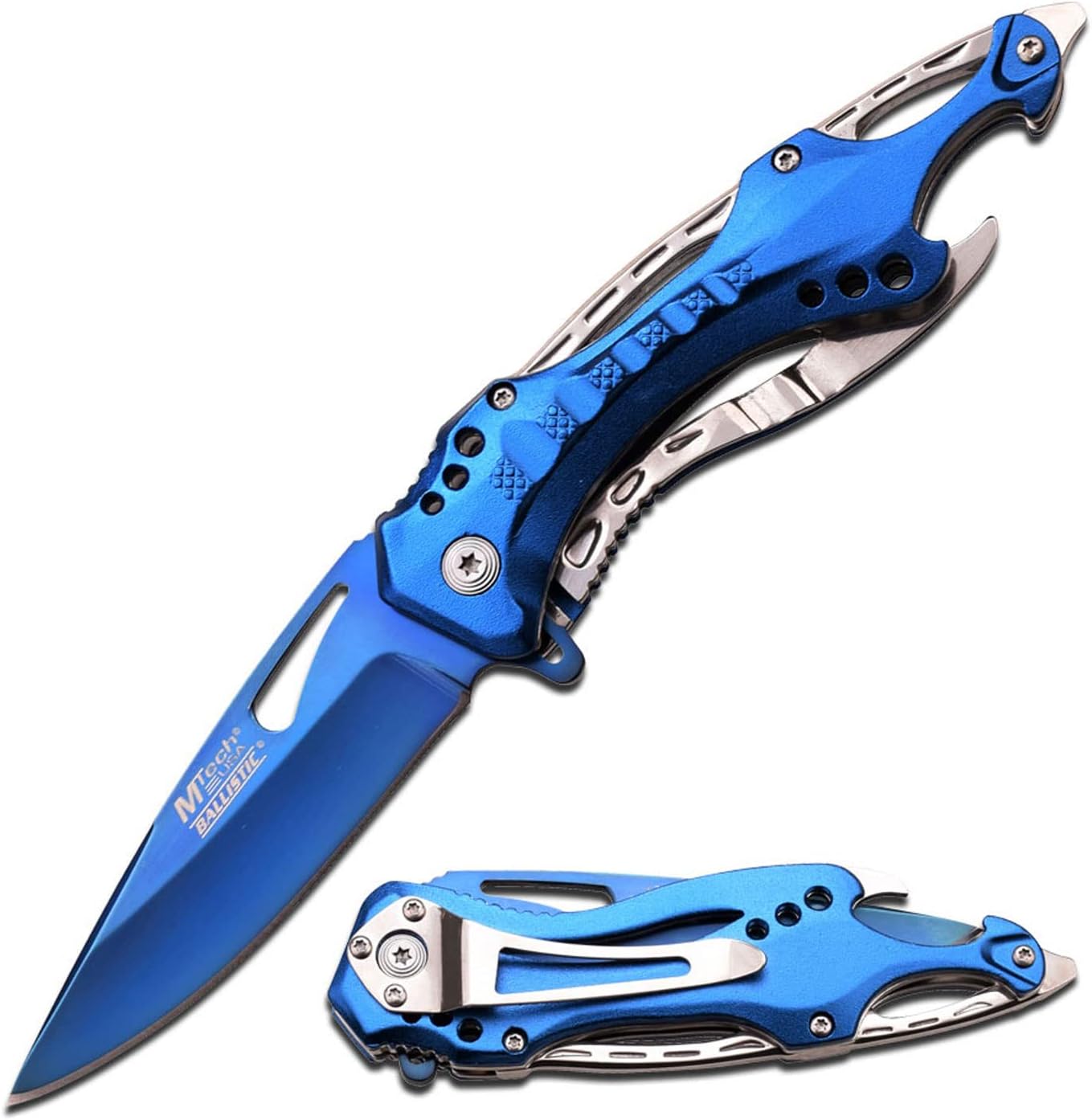
Ballistic Assisted-Opening Folder
The spring takes over once your thumb pushes the blade past the first inch. Aluminum scales sit over a skeletonized frame to keep the weight down, and the butt end works as a bottle opener.
Check availability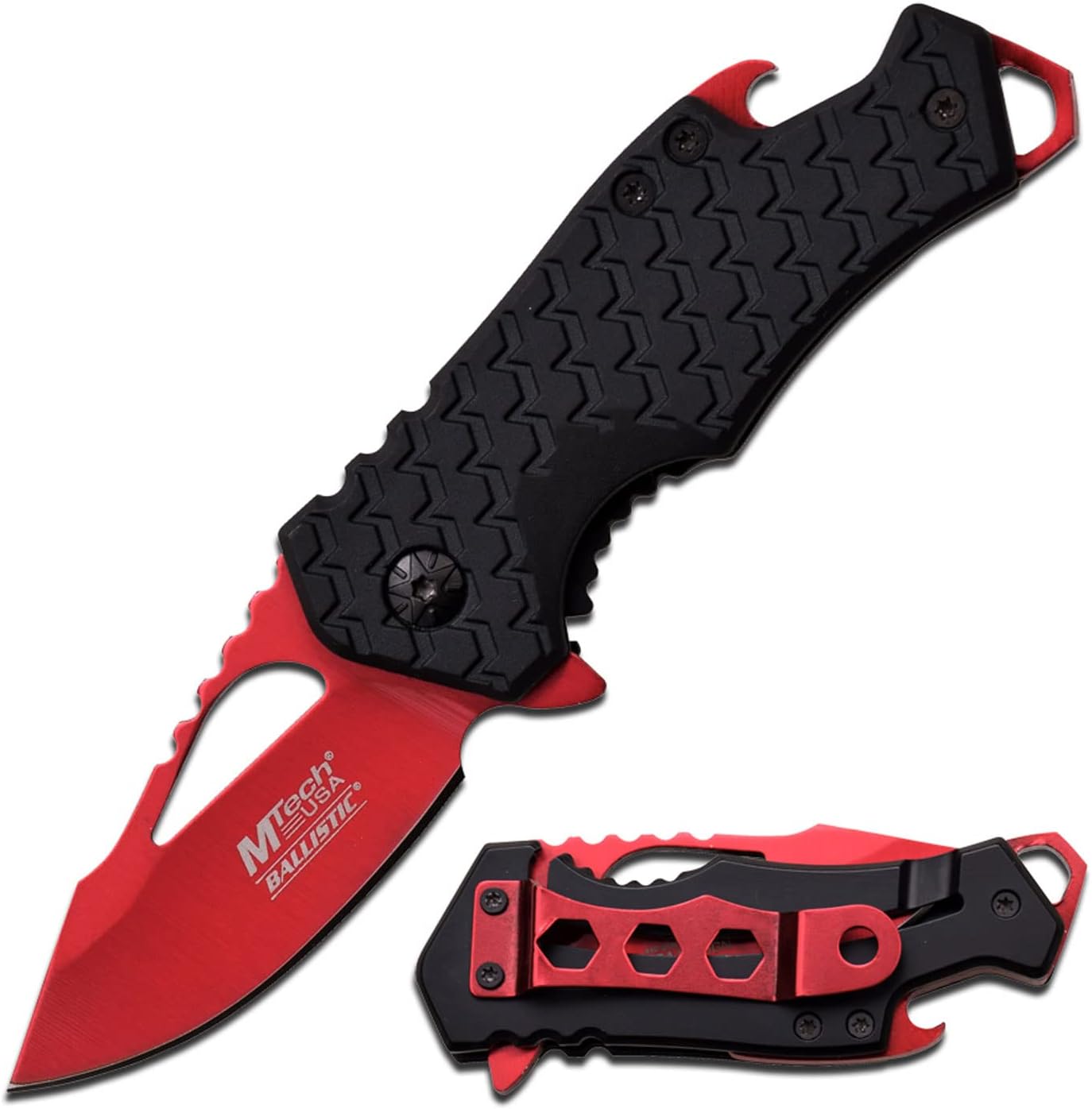
Compact Folder with Bottle Opener
Short enough to forget in a pocket. The tread-pattern rubber grip holds in a wet hand, and the steel clip carries three hex cutouts plus a bottle opener.
Check availability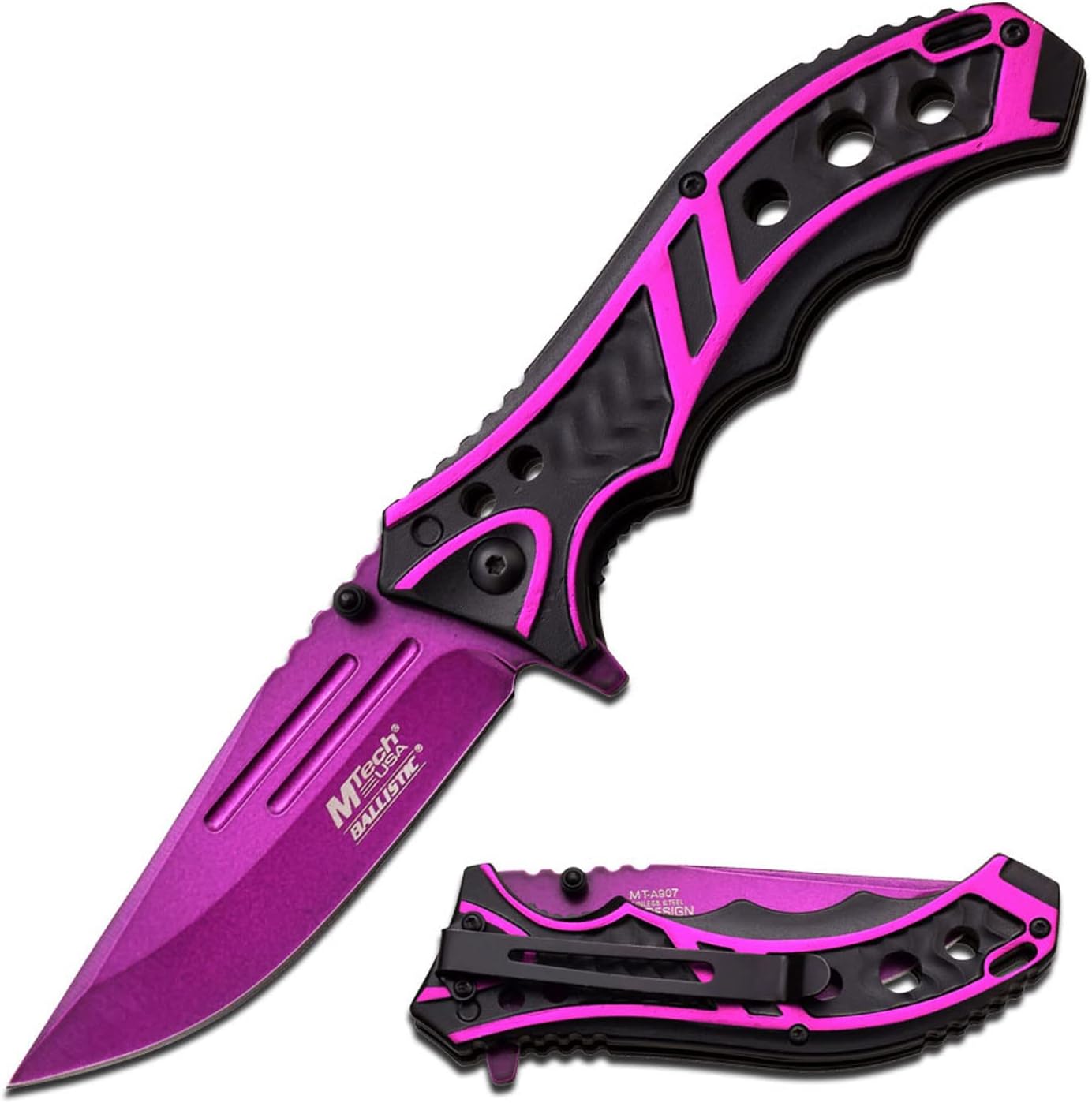
MT-A907 Spring Assist Folder
A full four-finger handle with thumb studs on both sides, so either hand opens it the same way. The drop point profile handles ordinary slicing better than an aggressive tip does.
Check availability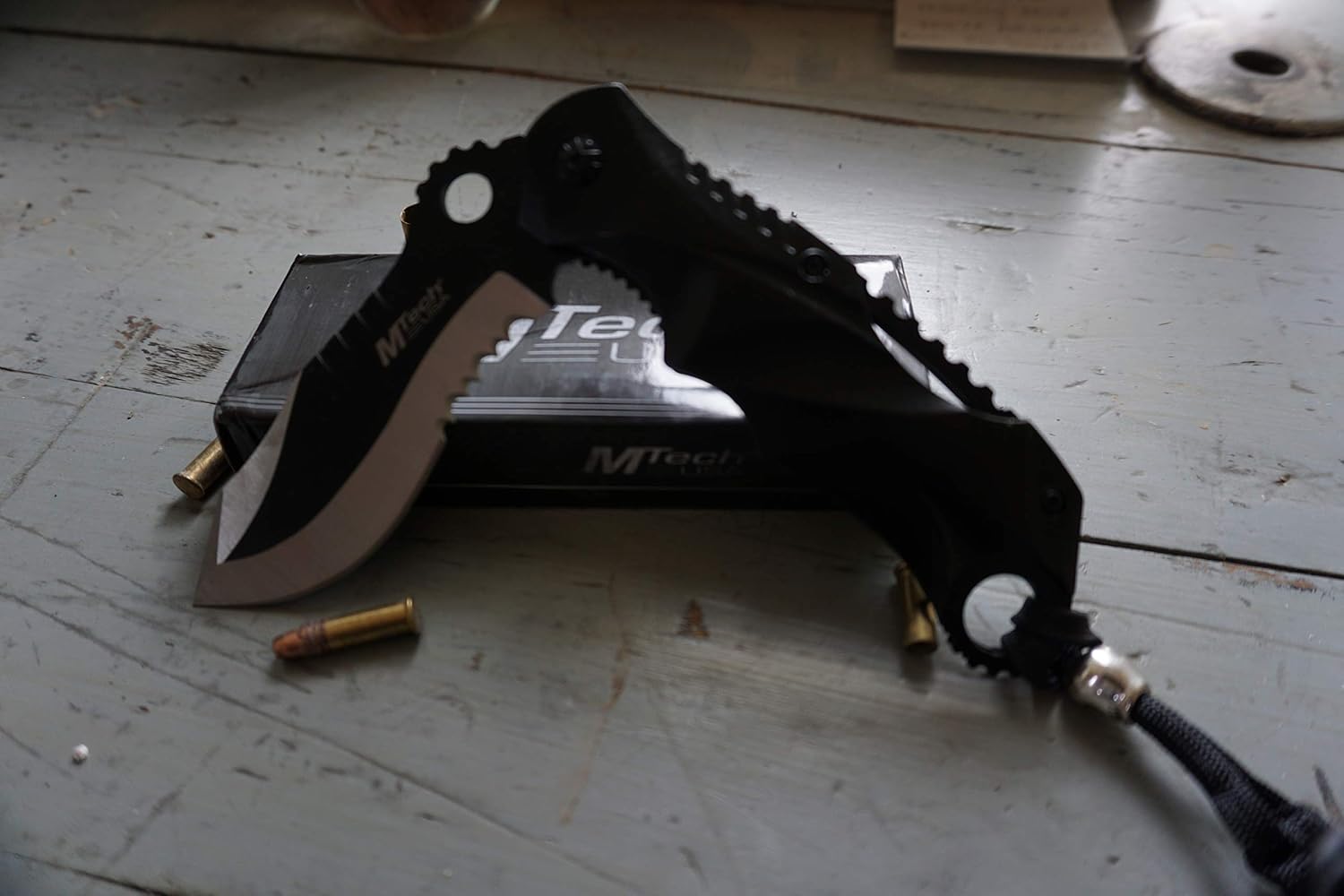
MT-A808 Assisted Opening Folder
Serrations at the heel of a recurved blade, which is the combination that chews through rope and webbing. A paracord lanyard runs through the butt of the handle.
Check availability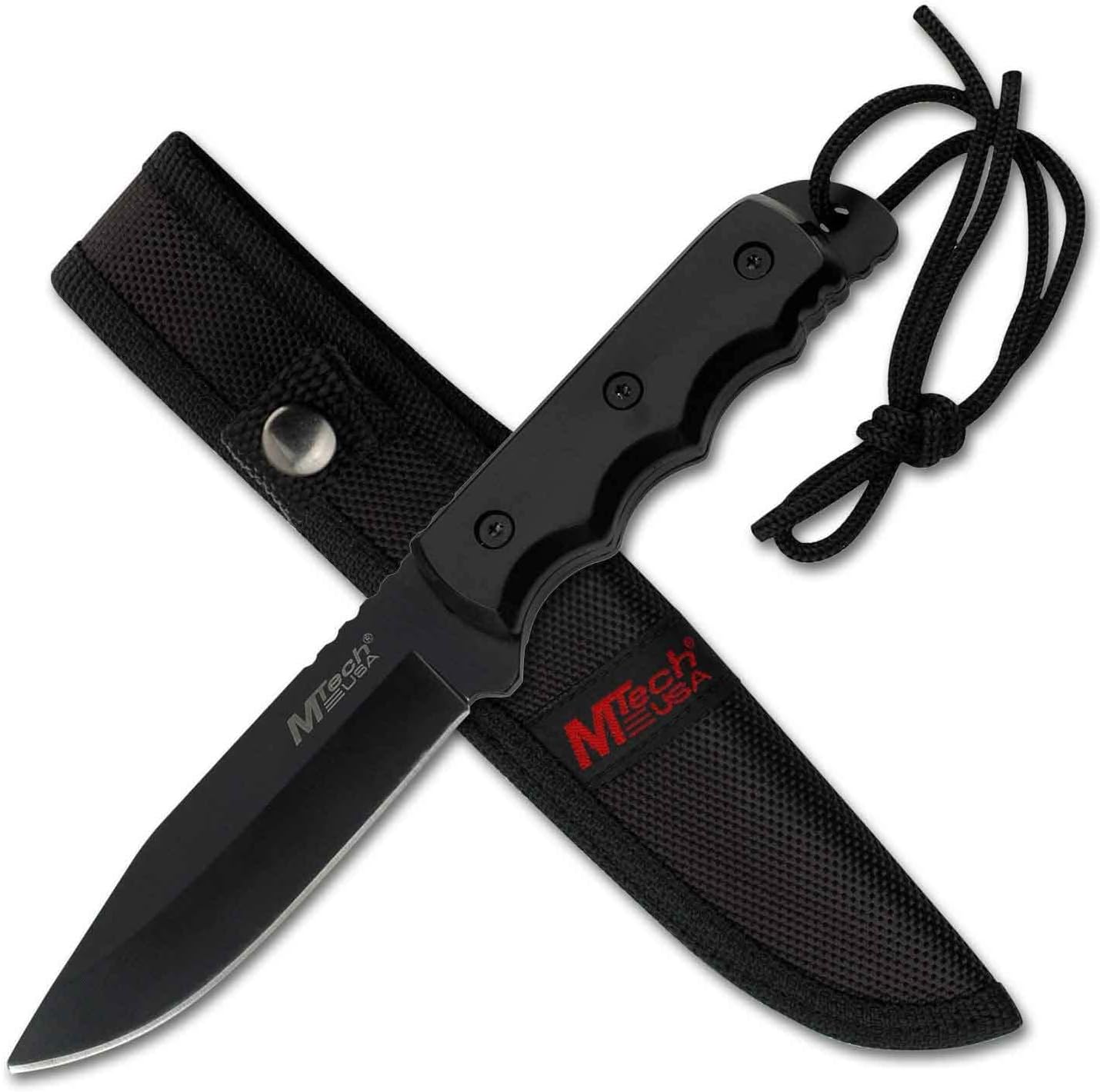
MT-20-35 Fixed Blade
No pivot to clog with sap or sand, which is the reason a fixed blade goes in a pack at all. Sawback teeth run along the spine and the molded sheath clips to a belt.
Check availability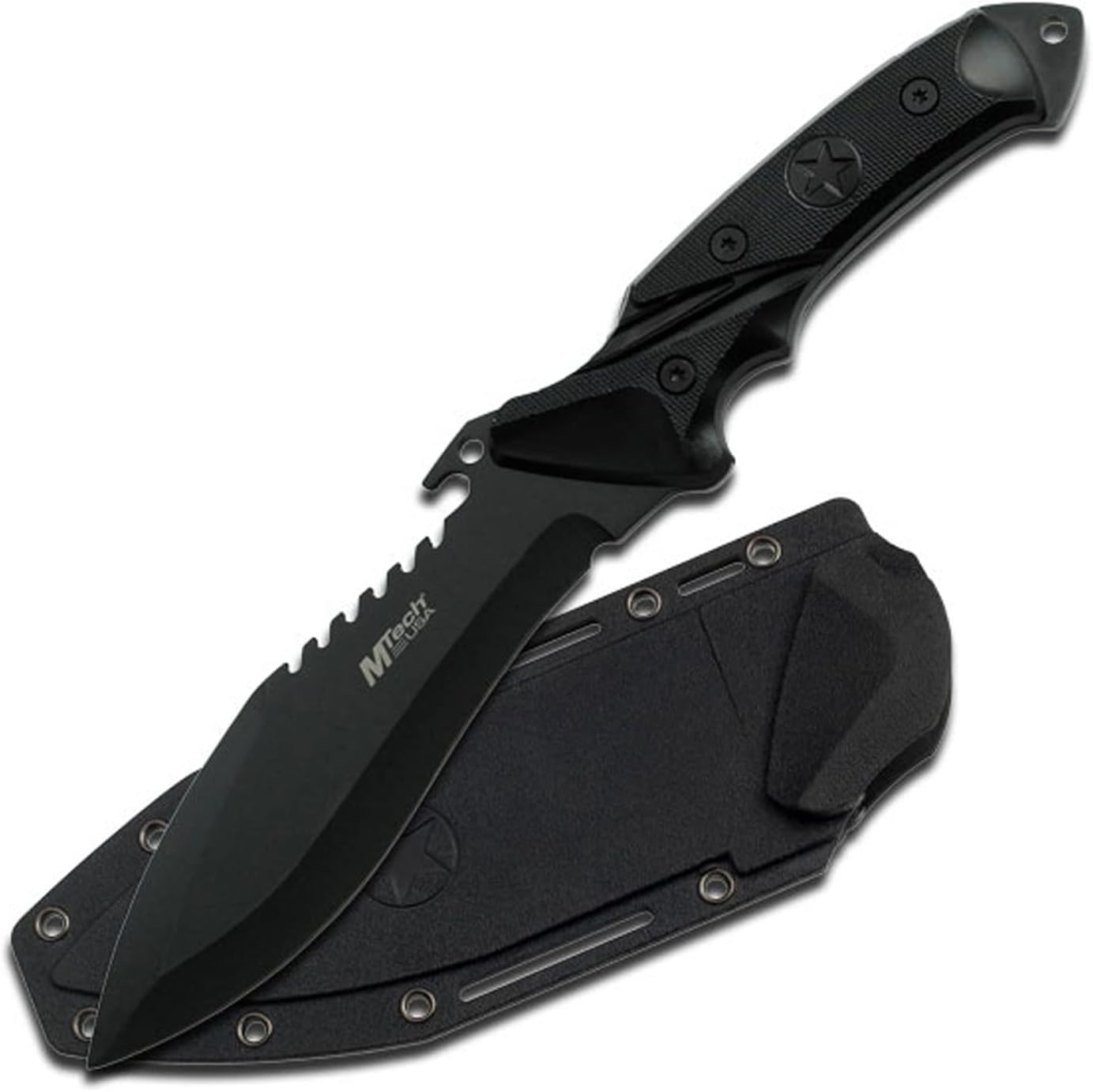
MT-20-12 Fixed Blade
A plain drop point in a nylon belt sheath and the least complicated knife on this page. Nothing on it loosens, and there is nothing to clean around after a messy job.
Check availability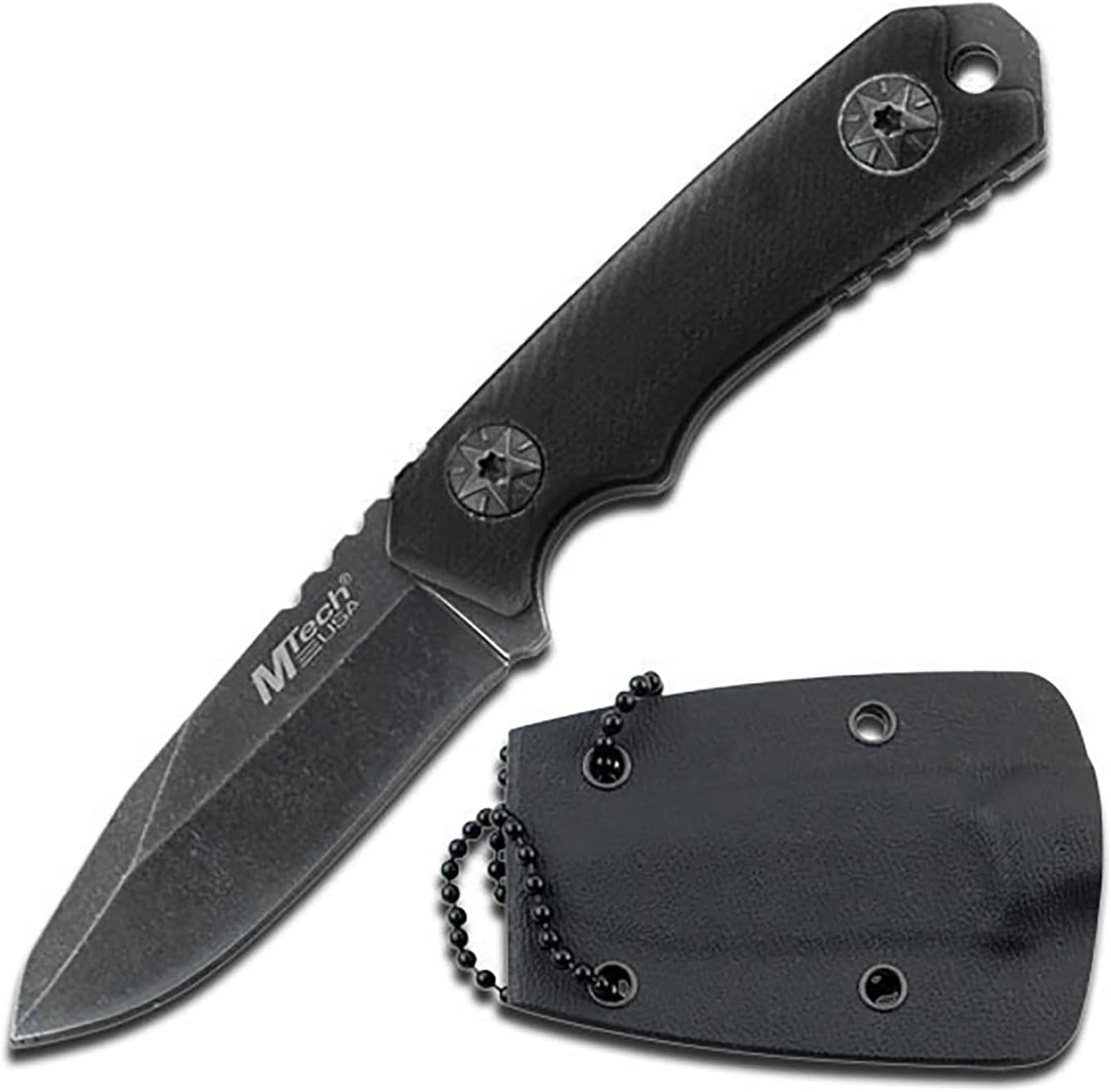
MT-20-30 Neck Knife
About the length of a thumb, carried on a ball chain in a molded sheath. G10 scales grip better than smooth metal, and the stonewash hides the scratches a flat black coating would show.
Check availability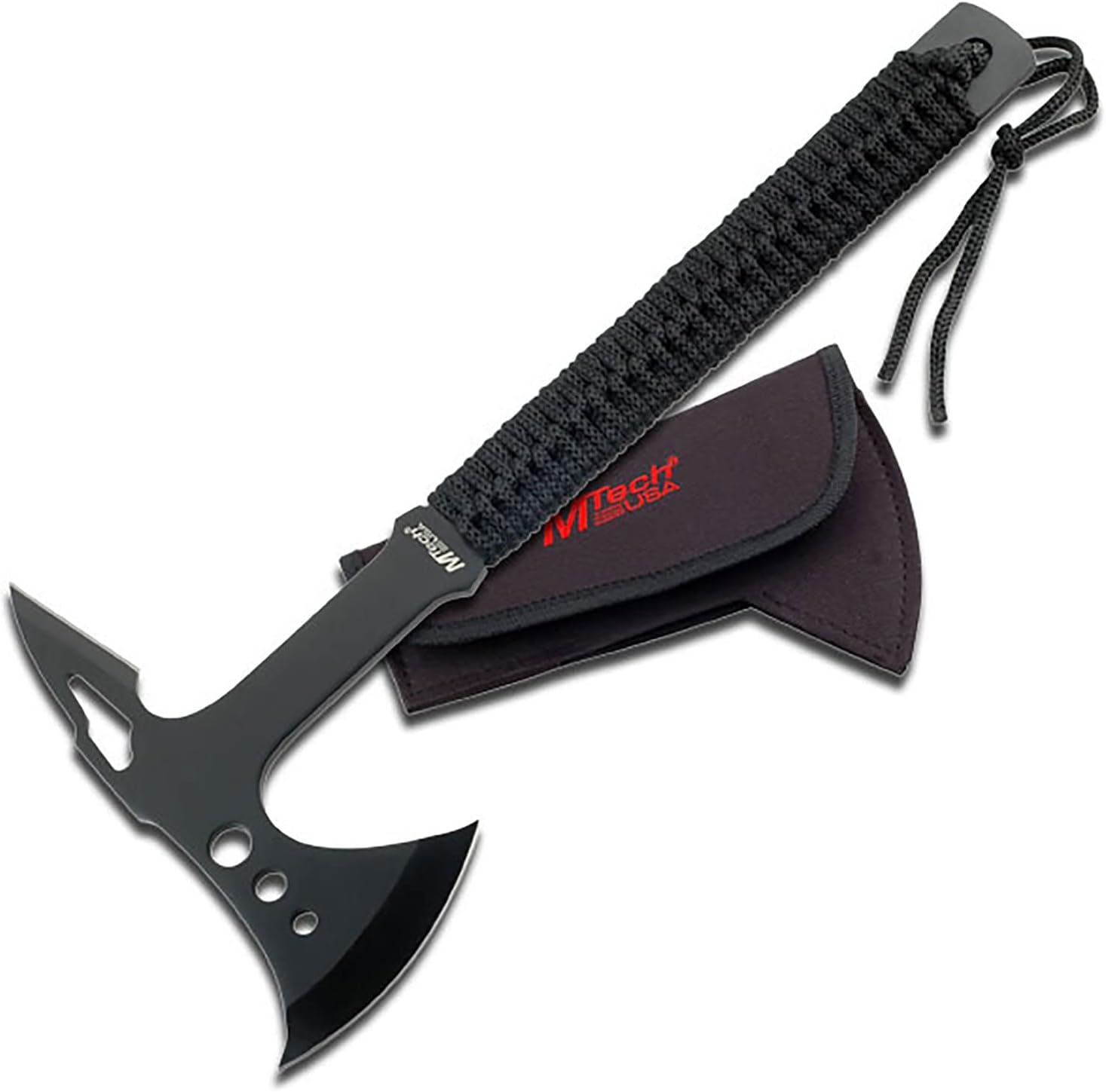
MT-AXE8 Camping Axe
Head and handle are one continuous piece of steel, wrapped in cord for grip. It handles kindling and tent stakes. A full-size splitting axe it is not, and the cord gets uncomfortable after an hour of chopping.
Check availabilityColors, finishes and themed pieces
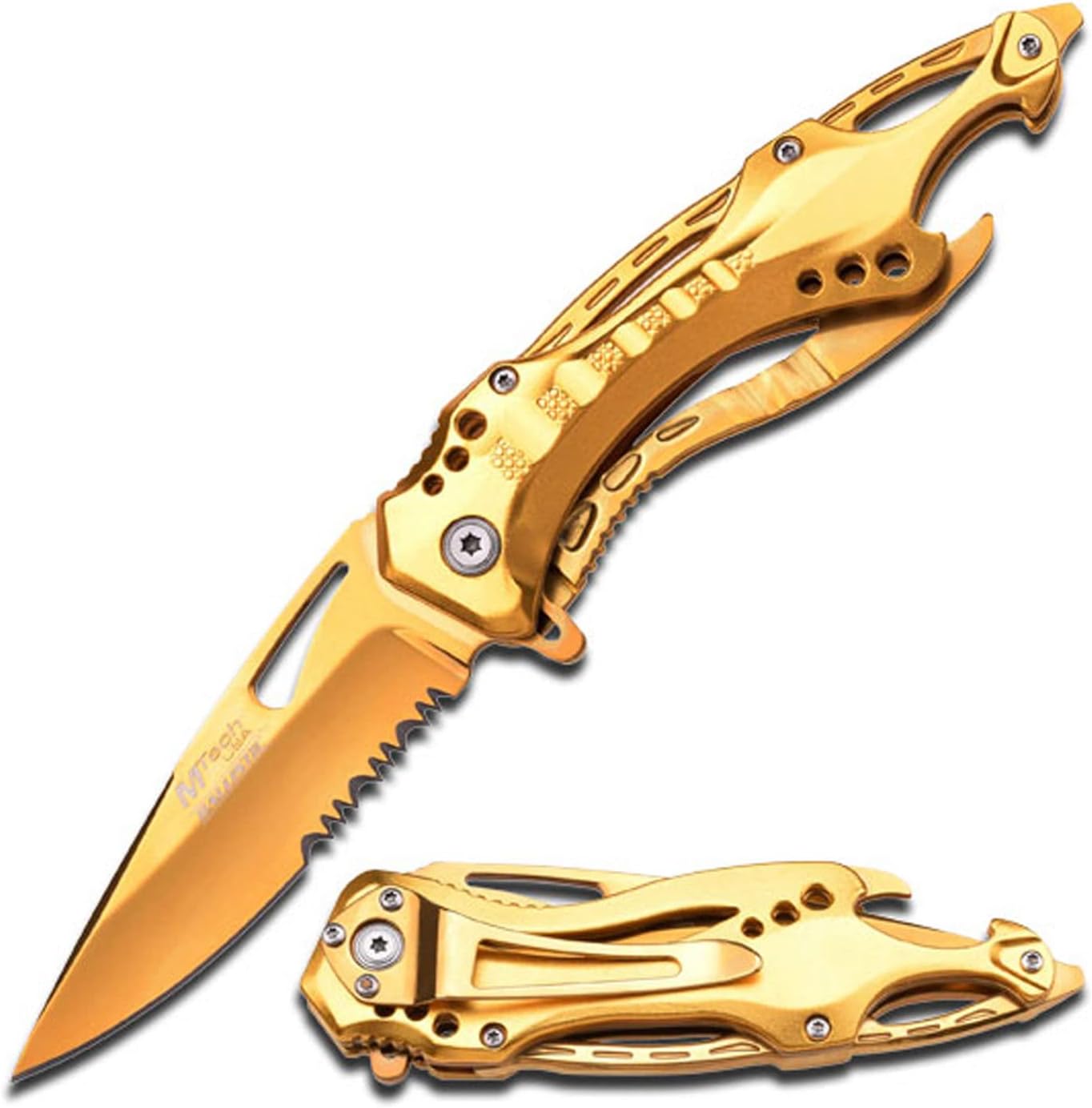
Ballistic, Gold
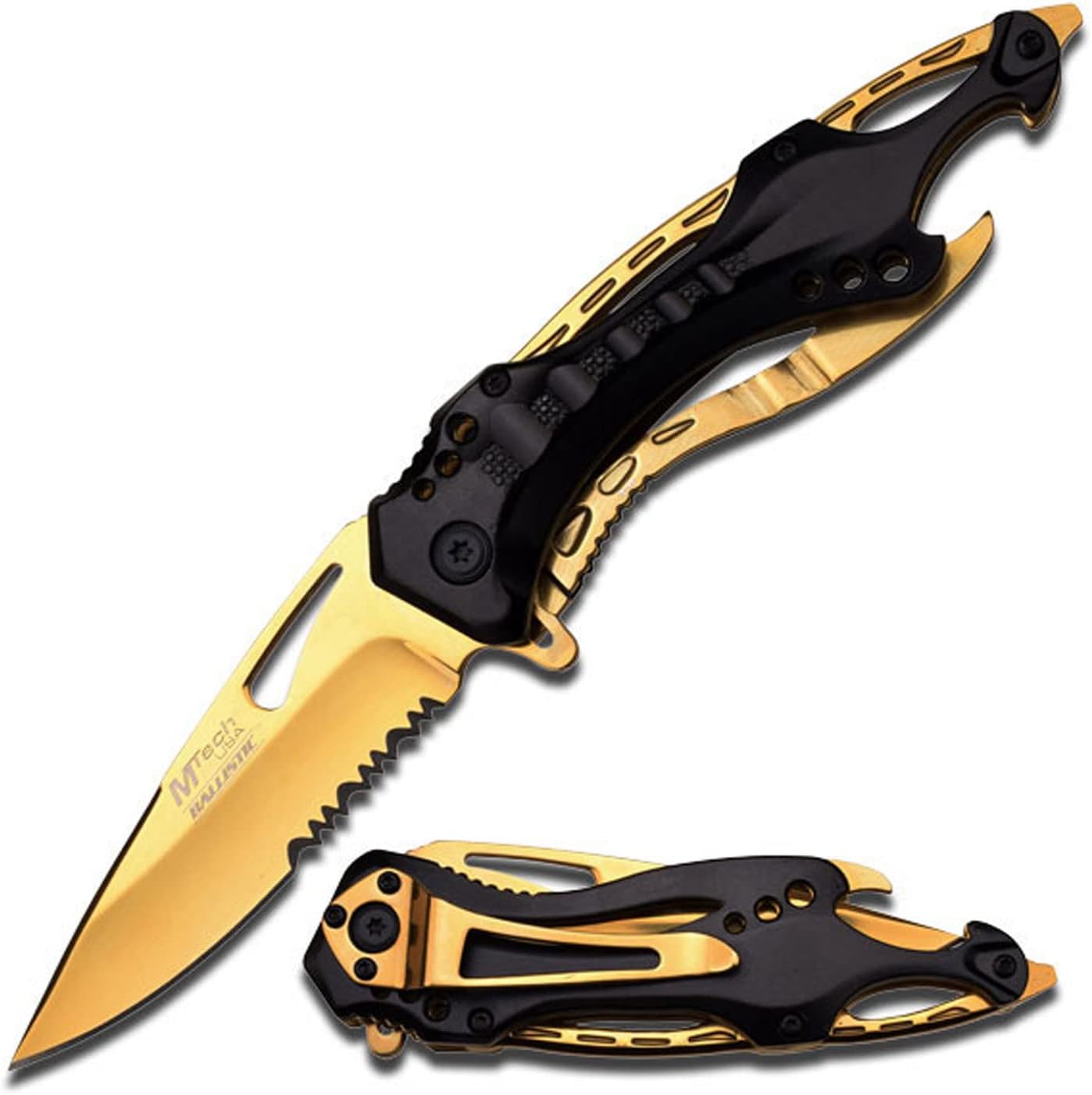
Ballistic, Black and Gold
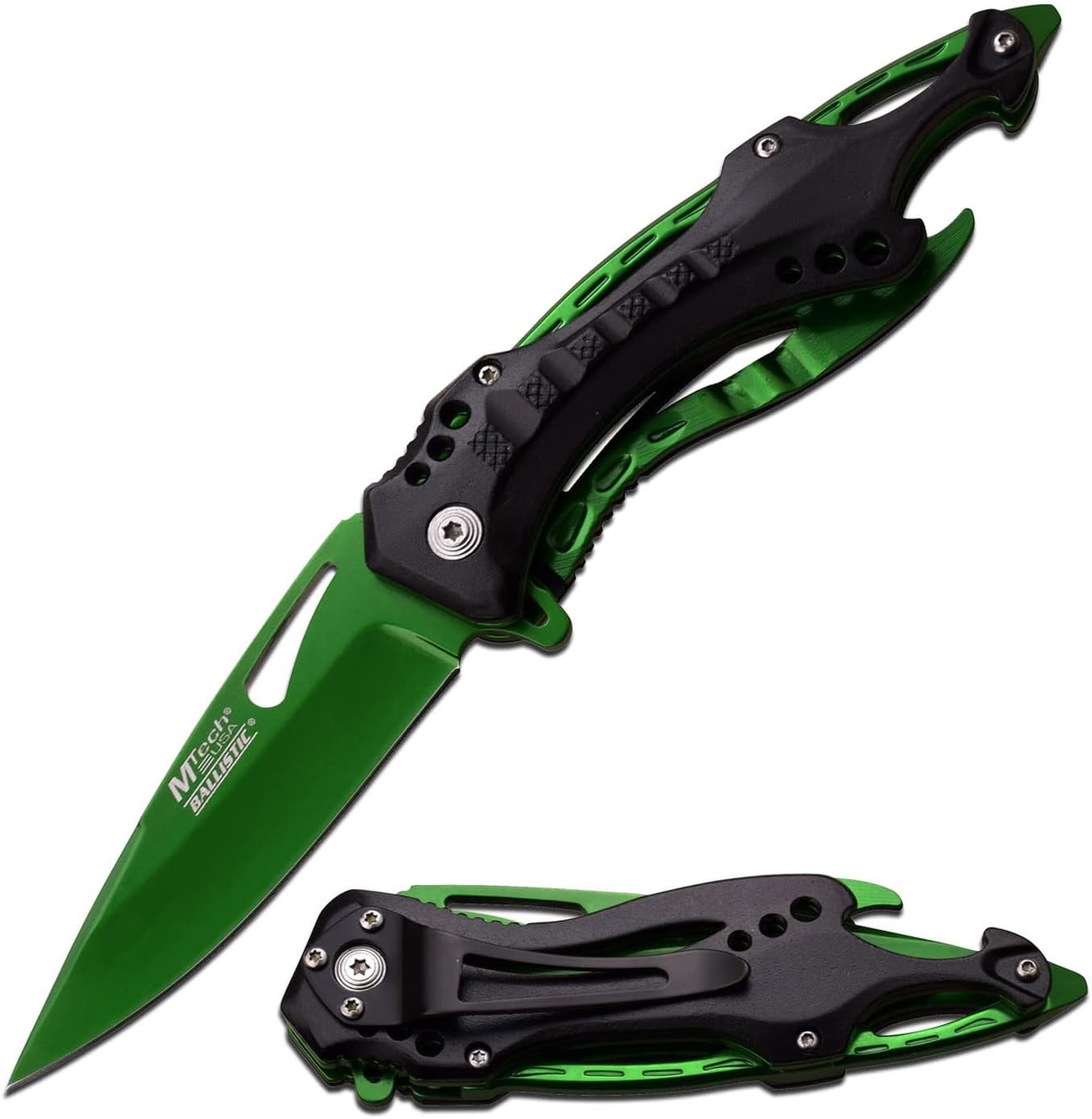
Ballistic, Green
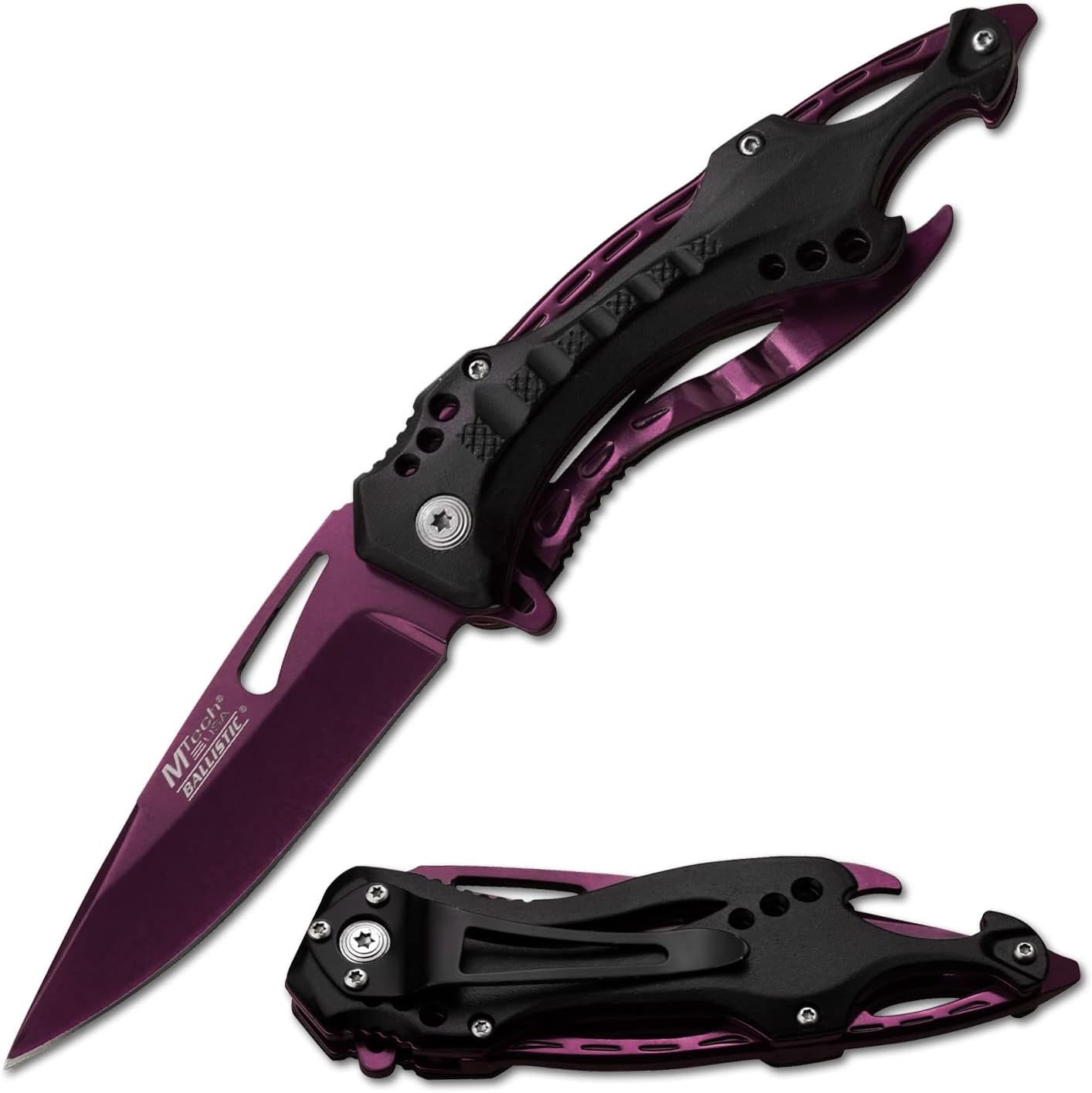
Ballistic, Purple
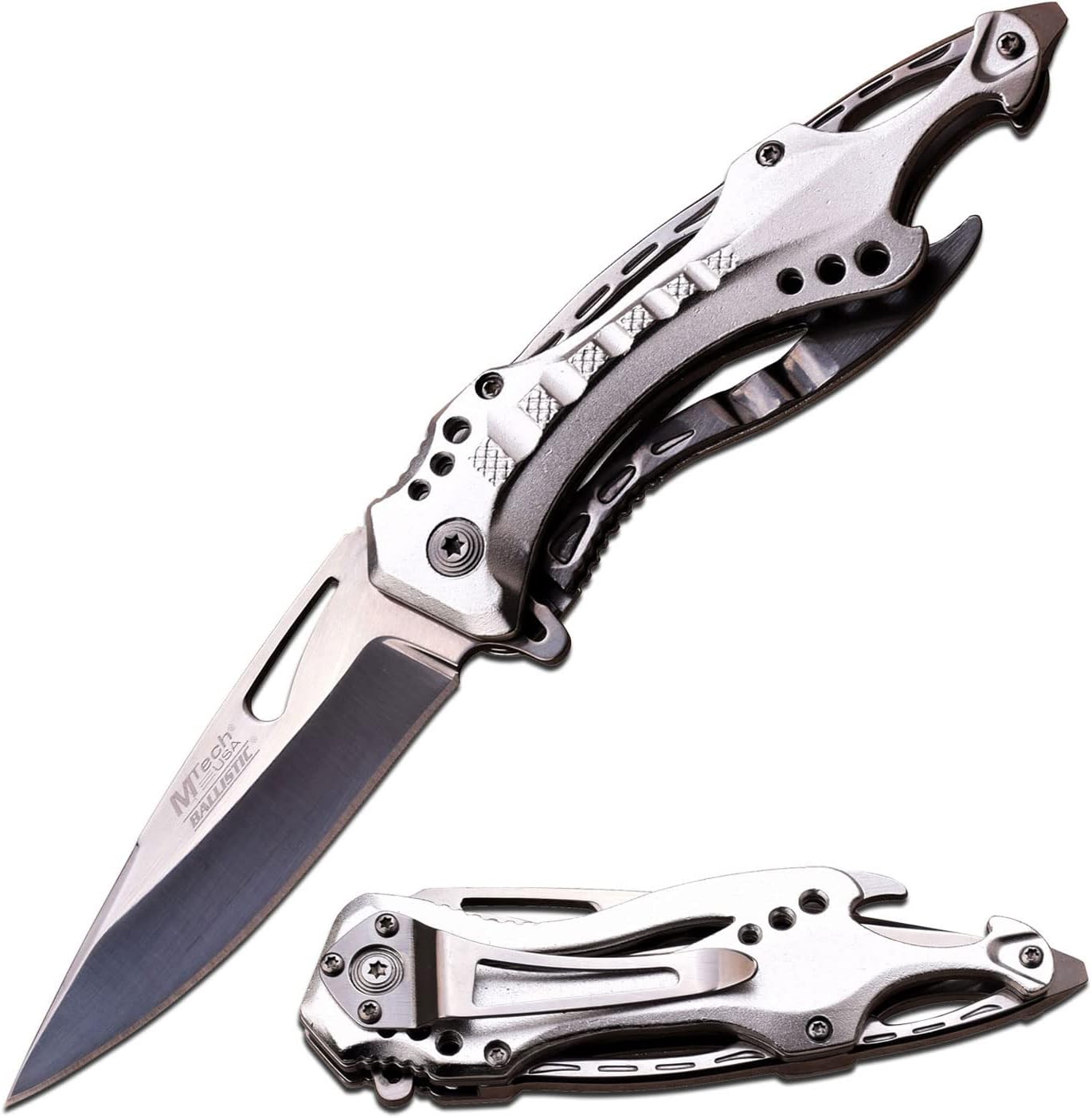
Ballistic, Satin
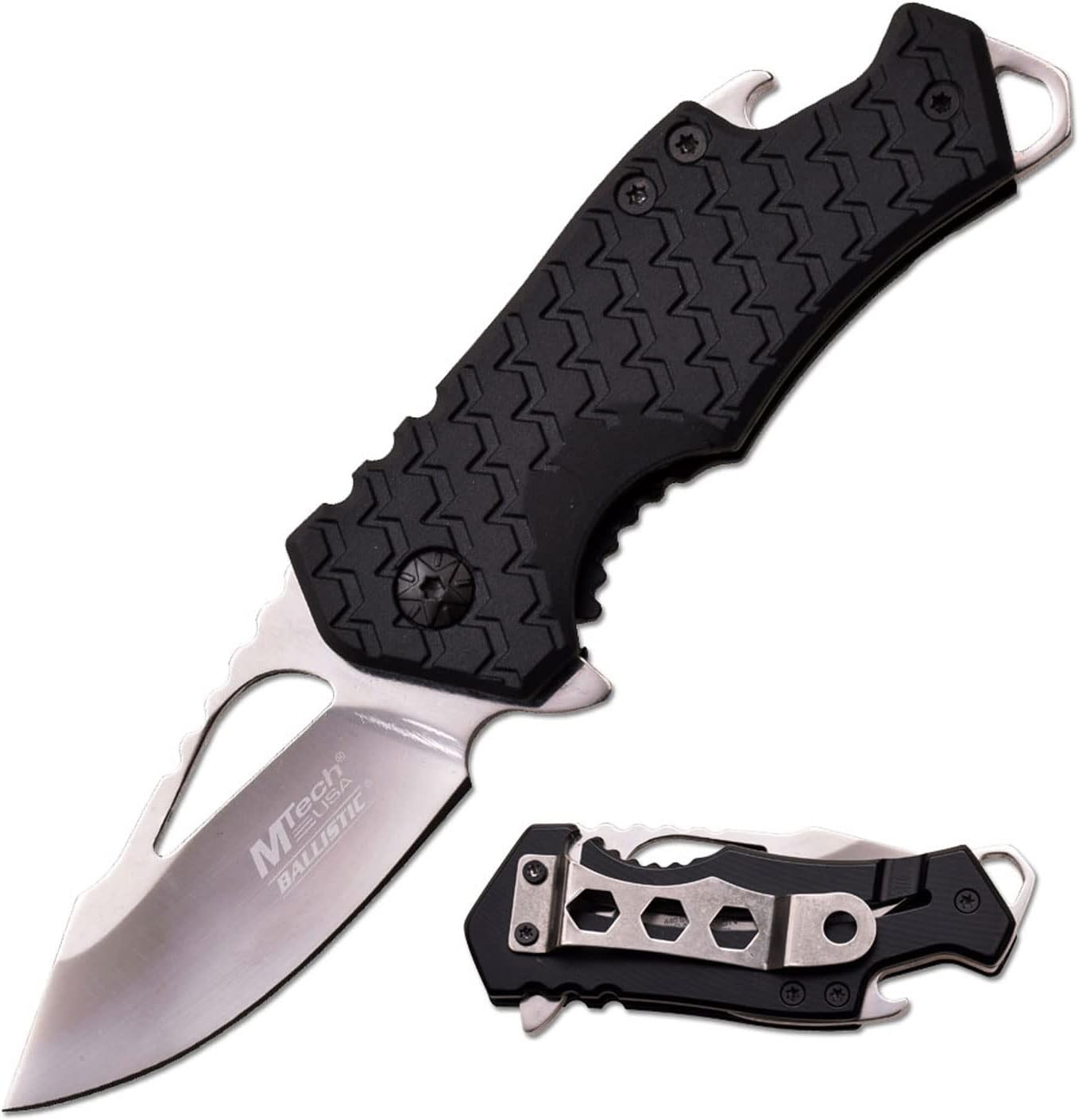
Compact Folder, Satin
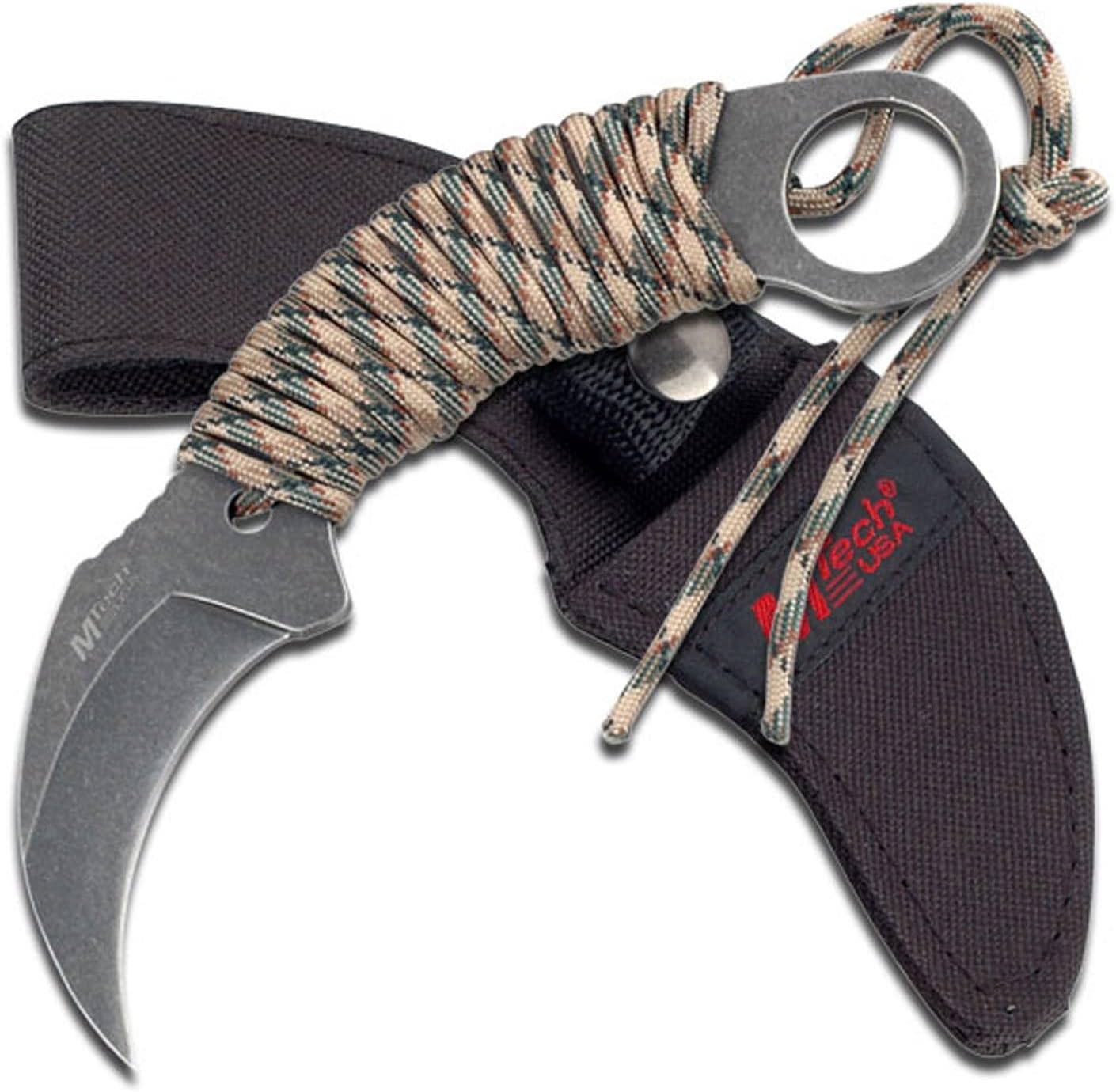
Karambit, Paracord
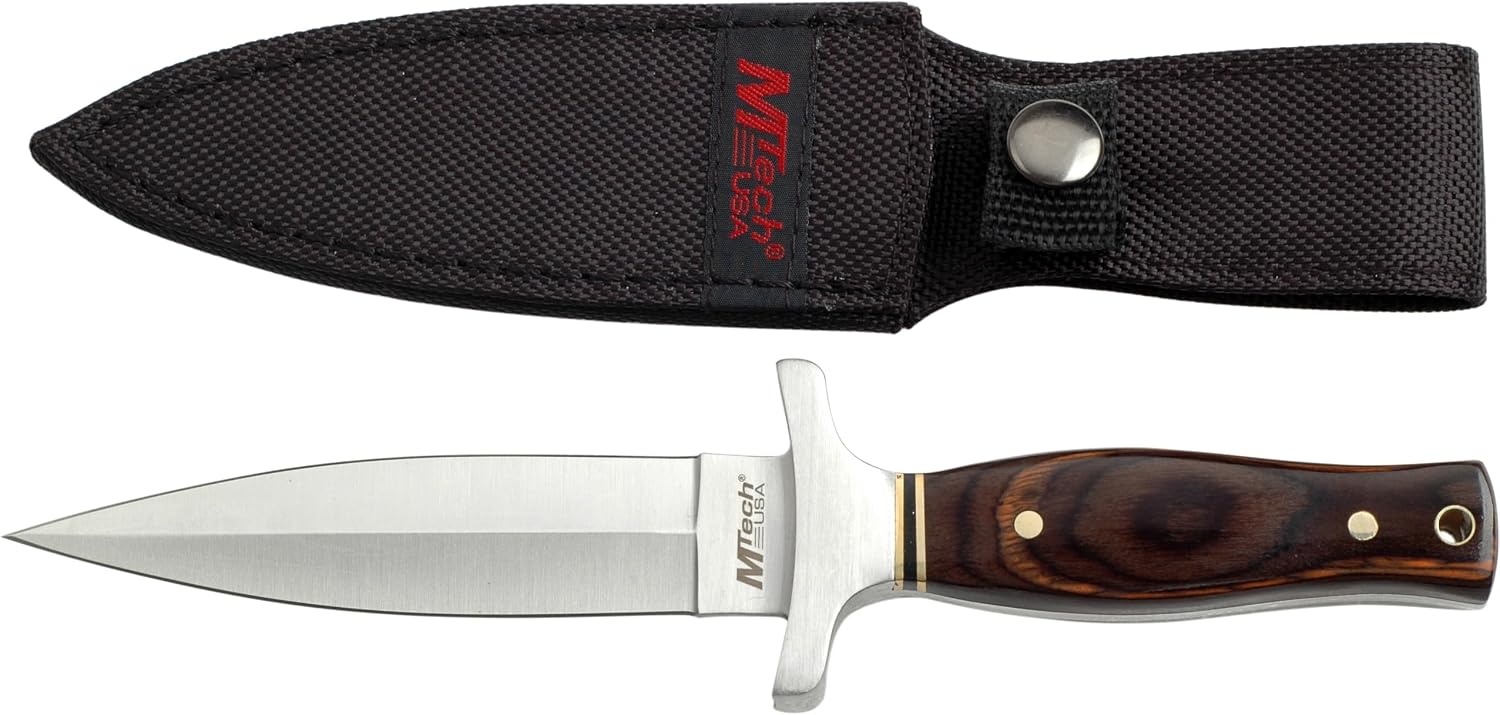
Boot Knife, Wood Handle
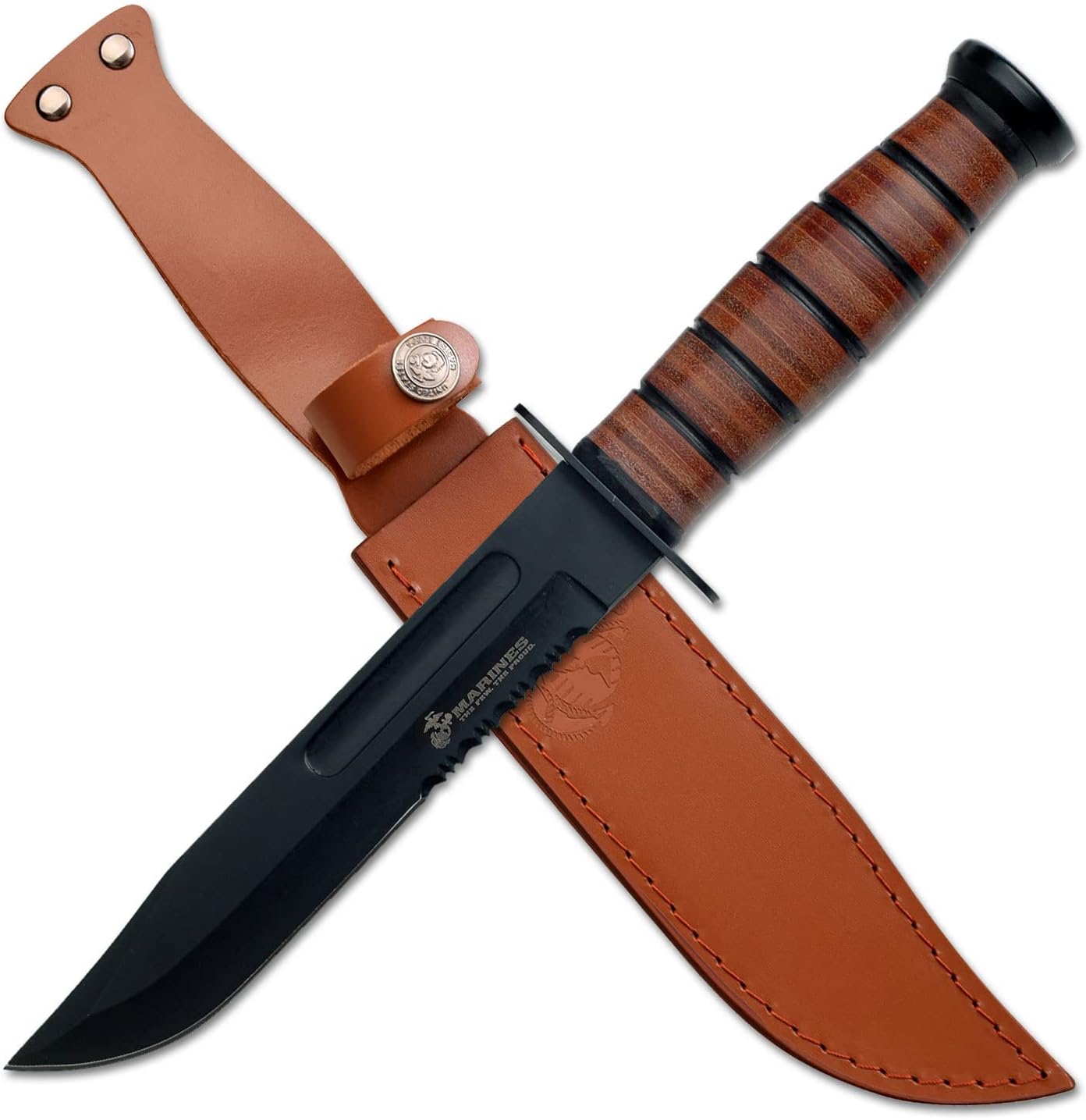
Leather Handle, Marines Theme
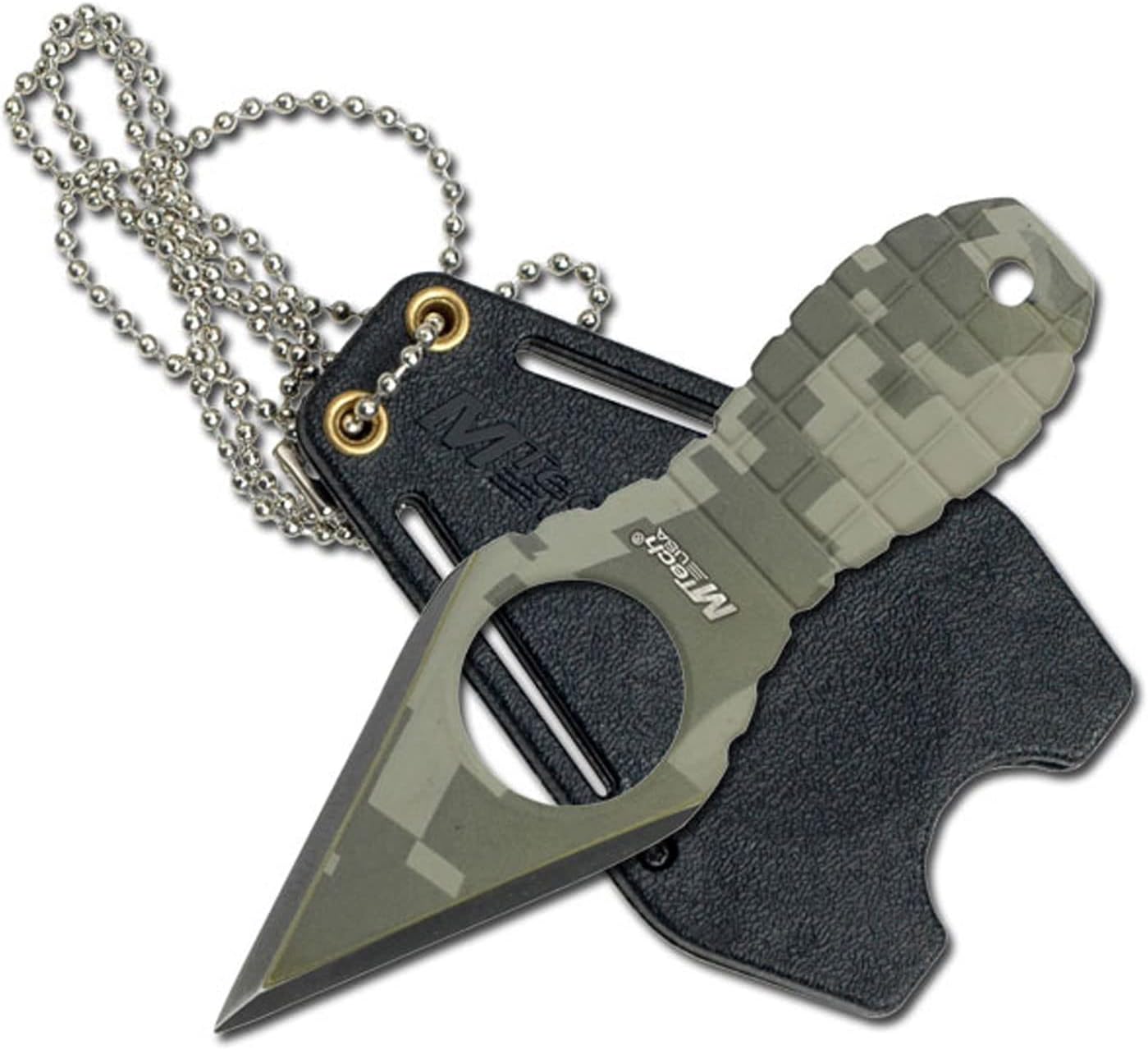
Neck Knife, Digital Camo
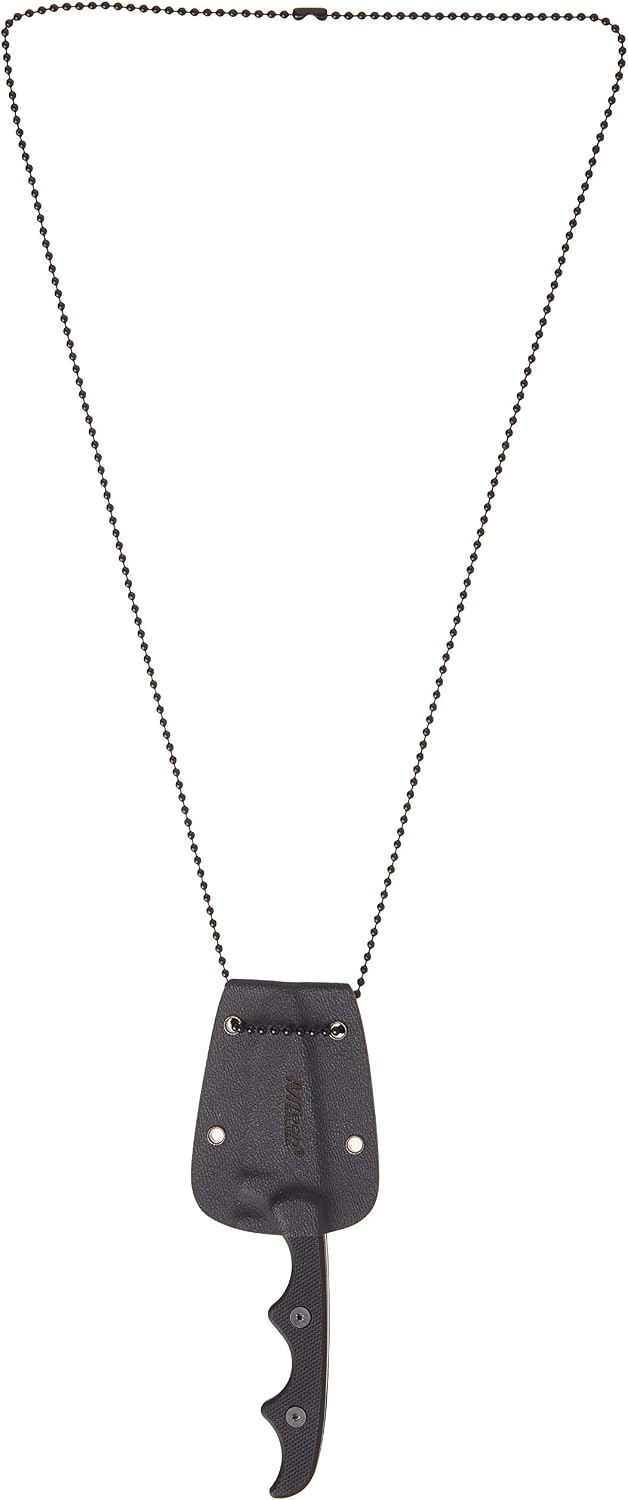
MT-673 Neck Knife
Military and department graphics mark a theme and nothing more. They carry no certification and no agency approval. Individual colors come and go from stock.
Folding Knife, Fixed Blade or Outdoor Tool
Take a pocket knife
An MTech pocket knife folds its edge into the handle, so it needs no sheath and rides on a clip all day. That single fact is why folders outsell everything else in the range.
- Boxes, cord, tape and the other small jobs of a week
- You want it in a pocket rather than on a belt
- A closed length near 4.5 inches fits most adult hands
- Check the clip: tip-up, tip-down and left-hand carry all exist here
Take a fixed blade
Nothing clogs and nothing folds. Sap, sand and fish scales rinse off a fixed blade in seconds and would need a toothpick to clear out of a pivot.
- Camp cooking, field dressing, splitting light kindling
- You would rather rinse a knife than clean a pivot
- Full tang matters to you, so confirm it on the model page
- You have a belt or a pack loop for the sheath
Take an axe or a machete
Chopping runs on mass and geometry rather than a keen edge. Once material stops yielding to a knife, more blade length or a heavier head is the answer.
- Kindling, limbs and dense brush
- The sheath has to cover a large edge in transport
- A tomahawk-style tool does not replace a splitting maul
- Check the handle for movement before each session
Start from the cutting you actually do in a normal month, then pick the size. A knife bought for an imagined emergency usually ends up in a drawer, and the one clipped in a pocket gets used every week.
Four Things to Check on Any MTech Knife
3Cr13 is an easy steel on purpose
Most MTech blades run 3Cr13 stainless. It comes back to sharp in a couple of minutes on an ordinary stone and shrugs off ordinary humidity. It also goes dull sooner than the powder steels on knives costing ten times more. For a blade that lives in a glovebox or a tackle box, that trade makes sense.
The lock does the work of keeping fingers attached
Liner locks turn up most often here. A strip of the inner liner springs behind the blade tang once the knife opens all the way, and your thumb pushes it aside to close. Open the blade fully every time, and keep fingers out of the closing path when the lock releases. Blade wobble or a lock that skips means the knife goes out of service until it is fixed.
Assisted opening is not an automatic
You start the blade with a thumb stud or a flipper and a spring carries it the rest of the way. Federal law separates qualifying assisted-opening knives from switchblades. States, counties and cities write their own definitions on top of that, so read the rules where the knife will actually be carried.
The sheath and the clip are half the purchase
A sheath that lets go of the blade turns a useful knife into a hazard at the bottom of a pack. Test retention the day it arrives. Clip position varies by model, so confirm the orientation on the listing if you carry left-handed or prefer tip-down.
Which MTech Knife for Which Job
| The job | Format that suits it | Worth knowing |
|---|---|---|
| Boxes, tape, zip ties | Compact folding knife | Use the edge, keep the tip out of it |
| Rope, webbing, seat belts | Partially serrated or rescue folder | Serrations need a tapered rod to sharpen |
| Camp cooking | Fixed blade, 3 to 4 inches | Rinses clean in a way a pivot never does |
| Field dressing | Fixed blade, hunting profile | A shorter blade gives finer control |
| Kindling and limbs | Axe or tomahawk | Head mass does the cutting, not sharpness |
| Brush and vegetation | Machete | Needs a clear arc and nobody standing in it |
| Backup or light carry | Neck knife | Retention matters more than blade length |
| Training and drills | Karambit | Sticks and trainers first, live blade much later |
- Cardboard blunts an edge faster than almost anything else in a house. That is abrasion doing its job, not a knife failing at its own.
- Coatings scratch wherever material rubs across them. A stonewashed blade disguises that wear and a flat black one records every mark.
- Twisting a blade sideways through material is how tips snap. A knife cuts. Prying belongs to a pry bar, and screws belong to a screwdriver.
- Finish tells you nothing about the alloy underneath. A gold-coated blade and a satin blade off the same production line are the same steel.
Two Reference Models
MT-378 Folding Knife
Reference pocket folder
- Blade length
- 3 in
- Blade steel
- 3Cr13 stainless
- Blade shape
- Tanto
- Closed length
- 4.5 in
- Overall open
- 7.5 in
- Lock
- Liner lock
- Carry
- Pocket clip
These numbers describe the plain end of the catalog, and they are the ones worth comparing against anything flashier. A 3-inch blade in a 4.5-inch handle clears most everyday cutting without filling a pocket, and the liner lock is the mechanism most owners already know how to use.
MT-AXE8B Tomahawk-Style Axe
Reference outdoor tool
- Head steel
- 3Cr13 stainless
- Construction
- Full tang
- Handle
- Cord wrapped
- Poll
- Spike
- Sheath
- Nylon
- Carry
- Belt loop on the sheath
- Format
- Compact camp tool
Full tang here means the steel of the head continues all the way through the handle rather than stopping behind the eye. Cord wrap gives grip and costs comfort, which shows up after twenty minutes of chopping and is why some owners tape over the wrap.
- Two knives carrying the MTech USA name can share nothing but the name. Blade length, closed length, steel, lock type, clip position and sheath material are listed model by model, and that listing settles any question a general description of the brand raises.
- Older listings name various 440-series stainless steels. What shipped under a model number in 2015 need not match what ships under it now, so trust the page for the knife you are actually looking at.
- Size decides what a tool can do and the category name on the box does not. Another axe in the range, the MT-AXE13SW, measures 14.5 inches overall on a rubberized nylon-fiber handle, which puts it in different work from a compact hawk.
MTech USA Reviews and Owner Photos
I ordered this knife to replace one from another company that I lost. I received it yesterday and haven't needed to cut anything yet, but it certainly looks nice and sharp. The blade is very sturdy and does not have any "give" or 'play' to it. It has a nice metal belt clip, but the knife is small enough to be easily carried in a pocket or thrown in a bug out bag without taking up much room. I LOVE the weed leaf design and the fact that it has a bottle opener built in. The only "cons" I can think of are that the spring is a bit stiff, but I know that opening and closing it will loosen it. I also don't like the "thumb cutout". I think that using screws would've been much better. Overall, those are minor complaints. This little MTech appears to be very good quality for a $10 "gas station" knife. I'd definitely recommend it.
CarrieFisherFan
I teach Kali/Escrima/Arnis. When students get to a certain level a Karambit can become necessary in their training. And I've always had a difficult time looking for a Karambit that I can recommend. I don't think it's right to tell a student to get a $200 Karambit. For the price this one delivers in every way that I ask a Karambit to be. Don't expect high grade steel or any kind of perfection in anyway. The bottom line is this is not for comfort, it's for training, and that's the most important to me. Please don't misunderstand that, I alway tell my students to train first with the sticks and training knife first, and earn your way to a real blade. You don't just start practicing with a knife like this. That is beyond dumb. For real life self-defense, the blade works fine, mine was actually razor sharp, but the paracord and sheath do not function. I took off my paracord and the sheath is sitting inside the box. It's affordable, it actually has a generous handle space for your hand, the ring is not jagged so it can be used for flipping, and I can wear gloves with it (my hands are average to slightly on the smaller side).
Wmpyr
Just got this in the mail. Very surprised that there are so few reviews/purchases of it: Stone wash texture looks and feels great and blade has zero visible imperfections. Sharp right out of the box. Only complaints are 1) the sheath is not ambidextrous and 2) the paracord wrap's lanyard end is a bit too long and can get in the way of the fingerhole. Neither of these pose a very big issue though, I planned on doing my own sheath build and re-wrapping the handle on my own. Insanely good deal for a very low price point, color me impressed.
Michael
You can carry it concealed because blade os less than 3inches.They also improved the sheath based on previous review that it easily cuts the cloth sheath.It is now reinforced with decent thickness.Wish they went with plastic sheath though.
primetimelime
This is the second such knife I've gotten from MTech because I lost the first. I like the clip and the bottle opener and the blade is fairly easy to sharpen and comes to you plenty sharp. In both cases, I actually removed the spring inside, because it allows me to open and close the knife easily with one hand.
John A
Very well packaged. Good fit & finish. Cord handle wrap is evenly and tightly wrapped. Came surprisingly sharp and ready for action, whatever that might be. Good size and weight. Smooth, black matte finish is flawless (until I chop something, of course). I'm almost disappointed, I never buy ANYTHING that I can't find something to bitch about. OK...if you had to do a lot of heavy chopping, the cord wrap would become uncomfortable, but I expected that and I planned to wrap over the cord with self adhesive camo tape anyhow. Overall I'm VERY pleased and I think most people who buy this tomahawk will be as well. Best 20 bucks I've spent in a long time. Oh, had to add, since sheaths are often a bone of contention. Fits OK, relatively sturdy nylon. Nothing to write home about, but it does its job. If for some reason you think you might need this for self defense....get it out now, cause it takes a while. This is definitely no quick release sheath. ;') Does have a nylon belt loop, unlike say, the CS Trench Hawk, which has a cool, cleverly designed, hard sheath but...DUH...no way to attach it to ....anything....which is not so clever.
bikehunter
Sharpening, Cleaning and Storage
- 1
Follow the bevel already on the blade
Match the angle the factory ground rather than inventing a new one. Changing geometry removes far more steel than maintenance does, and 3Cr13 responds well to a light touch on a medium stone.
- 2
Start coarse only when the edge is damaged
A rolled or chipped edge needs a coarse abrasive to reset it. An edge that has simply gone dull from cardboard and cord comes back on a fine stone in a couple of minutes.
- 3
Sharpen serrations one at a time
Use a tapered rod that fits inside the individual scallops, working from the beveled side only. Keep the points between serrations intact, since flattening them is what ruins a serrated section for good.
- 4
Clean and dry before it goes away
Wipe off food, sap, salt and moisture, then dry the blade completely. Stainless resists corrosion rather than ignoring it, and trapped moisture inside a sheath will find any gap in the coating.
- 5
One drop of oil at the pivot
When a folder starts feeling gritty, a single drop of light oil at the pivot fixes it. More than that collects pocket lint, which is the actual cause of most stiff folders.
- 6
Check the screws every few months
Pivot and pocket-clip screws back out slowly on a knife carried daily. Use a driver that fills the head properly, because a stripped torx screw on a budget folder is not worth the repair.
Never try to catch a falling knife. Move your feet, let it land, and pick it up afterward.
A knife that has been dropped hard, pried with or run over deserves an inspection before the next use. A cracked scale, a bent lock bar or a chipped tip changes how the tool behaves in the hand.
For long storage, dry beats sheathed. Some sheath materials hold moisture against steel for months, and that is where surface rust comes from on a knife that was never used.
Knife laws are local. Blade length limits, concealed carry rules and restrictions on assisted-opening mechanisms vary between states and between cities inside one state, and buildings such as schools and courthouses add their own. Check the rules where the knife will be carried.
About MTech USA
MTech USA belongs to Master Cutlery, a company founded in 1982 that develops knives and edged tools across several brands. MTech USA knives first reached American buyers on February 13, 2003, covering utility, folding, hunting and tactical knives from the start.
The range grew wide rather than deep. One brand family now holds a 3-inch liner-lock folder, a 9-inch fixed blade, rescue folders with seat-belt cutters, neck knives on ball chains, karambits, machetes and cord-wrapped axes. Two knives with the same logo on the blade may share nothing beyond that logo, which is why specifications get compared model by model here and never brand-wide.
Pricing sits at the accessible end of the market, and the engineering matches it. Blades are usually 3Cr13 stainless rather than a premium powder steel, locks are conventional liner locks and lockbacks, and handles run from stamped steel frames to aluminum, G10 and cord. What that buys is choice: a size, a blade shape, an opening mechanism and a finish, without the price of a boutique folder.
The name gets typed several ways. M Tech, MTECHUSA and MTech knives all point at the same brand, and listings use the variants interchangeably. The logo stamped on the blade reads MTech USA, often alongside a series name such as Ballistic.
MTech USA FAQ
MTech USA is a knife and edged-tool brand owned by Master Cutlery. The MTECH USA trademark was filed in 2003 for utility, folding, hunting and tactical knives, and the first MTech USA knives sold in the United States on February 13, 2003. The brand has since spread across folding knives, fixed blades, axes, machetes, rescue knives and other outdoor tools.
Master Cutlery owns MTech USA. Master Cutlery was founded in 1982 and develops knives, edged tools and related equipment under several brands, with a catalog running past 2,600 active SKUs across more than 100 product segments.
Folding pocket knives, fixed blades, assisted-opening knives, hunting knives, rescue models and neck knives, plus larger outdoor tools such as axes, tomahawk-style hawks and machetes. Individual designs vary enormously in size and construction, so check specifications model by model rather than assuming them from the MTech USA name.
Many of the folders are sized for it, particularly models with a pocket clip, a blade near 3 inches and a conventional lock. The MT-378 is a fair example: a 3-inch blade, 4.5 inches closed, liner lock, pocket clip. The larger tactical folders weigh considerably more and fill a pocket, which works against them if compact carry is the goal.
3Cr13 stainless steel appears on many current MTech USA knives and axes, though steel varies by model and other MTech products have shipped with different stainless alloys. 3Cr13 is an entry-level stainless cutlery steel. It sharpens easily and resists corrosion well enough for ordinary use, and it needs sharpening sooner than premium steels built for wear resistance. That matches the accessible pricing across most of the range.
A manual folder opens entirely on your own movement, whether that comes from a thumb stud, a thumb hole or a nail nick. An assisted-opening knife still needs you to start the blade moving, and then an internal mechanism carries it through the rest of its travel. An assisted-opening knife is not an automatic knife or a switchblade. U.S. federal law distinguishes qualifying assisted-opening knives from switchblades, and state and local laws can still impose their own restrictions on top.
Liner locks are the most common. A section of the inner liner springs behind the blade tang once the knife opens, and you push it aside to close. Other models use frame locks, lockbacks, button-operated systems or less conventional arrangements such as the DLM handle lock. Confirm the blade has opened completely and the lock has engaged before cutting. A folder with excessive blade play, damaged components or inconsistent lockup should stay closed until the problem is fixed.
Choose a folder when pocket carry and compact storage decide it. The blade folds into the handle, which covers the edge without a separate sheath and halves the stored length. Choose a fixed blade when simplicity, easy cleaning or the absence of a pivot matters more. Fixed blades suit outdoor and hunting work, and they need a secure sheath and more room in transport.
Yes, some fixed blades and axes use full-tang construction, which means the blade steel continues through the handle instead of stopping shortly behind the blade. Not every fixed-blade product in the range is full tang. The MT-AXE8B tomahawk-style axe is one example, specified with full-tang construction, a 3Cr13 stainless blade, a cord-wrapped handle and a nylon sheath. Check the individual model when tang construction matters to you.
A plain edge gives one continuous cutting surface. It sharpens on any flat stone and handles controlled slicing, cardboard, packaging and most routine jobs. A partially serrated blade adds teeth along part of the edge. Those teeth bite into rope, webbing and other fibrous material, and they need a tapered rod to sharpen. They also leave less uninterrupted plain edge for everything else.
Yes. Rescue-oriented folders in the range have carried seat-belt cutters and glass breakers, including models with firefighter and EMT styling. Those features are model-specific rather than standard on every tactical-looking folder, so read the exact description before relying on a knife for an emergency function. Fire department, EMT, police and military graphics describe a theme and indicate no professional certification or agency approval.
No. The range extends into axes, tomahawk-style tools, machetes and other outdoor equipment. Construction varies substantially between products. The MT-AXE13SW measures 14.5 inches overall with a 3Cr13 stainless head, a rubberized nylon-fiber handle and a nylon sheath, and the MT-AXE8B takes a different route with full-tang construction and a cord-wrapped handle.
Follow the bevel already on the blade unless you have a specific reason to change the geometry. A standard stone or a guided sharpener maintains most plain edges. Reach for a coarse abrasive only when the edge is damaged or badly dull, then finish on something finer. Serrated sections need a narrow rod that fits the individual scallops. Remove as little steel as possible, especially near the points between serrations.
Wipe off dirt and residue after use, dry the blade completely and keep moisture away in storage. A folder that starts feeling rough at the pivot wants one drop of light oil, not more; excess oil collects pocket lint and grit. Inspect the pivot, lock, handle hardware and pocket clip every few months. Stainless steel is corrosion resistant rather than corrosion proof, and salt, acids, humidity or trapped moisture can still leave discoloration or rust.
That depends on the knife and the jurisdiction. Blade length, opening mechanism, concealed carry, location and knife type all affect the answer, and a knife permitted under federal law can still be restricted by a state, county, city, school, government building or workplace. Check the current rules where the knife will actually be possessed and carried. This matters most for assisted-opening knives, long blades, concealed fixed blades and designs that fall under specialized local definitions.
Pick the Format, Then the Finish
Two questions settle most of these orders. Does the knife ride in a pocket or on a belt, and does it need to handle camp work or open packages? Color comes last, and it changes nothing about the steel underneath.
Shop MTech USA